It rarely starts with a crisis.
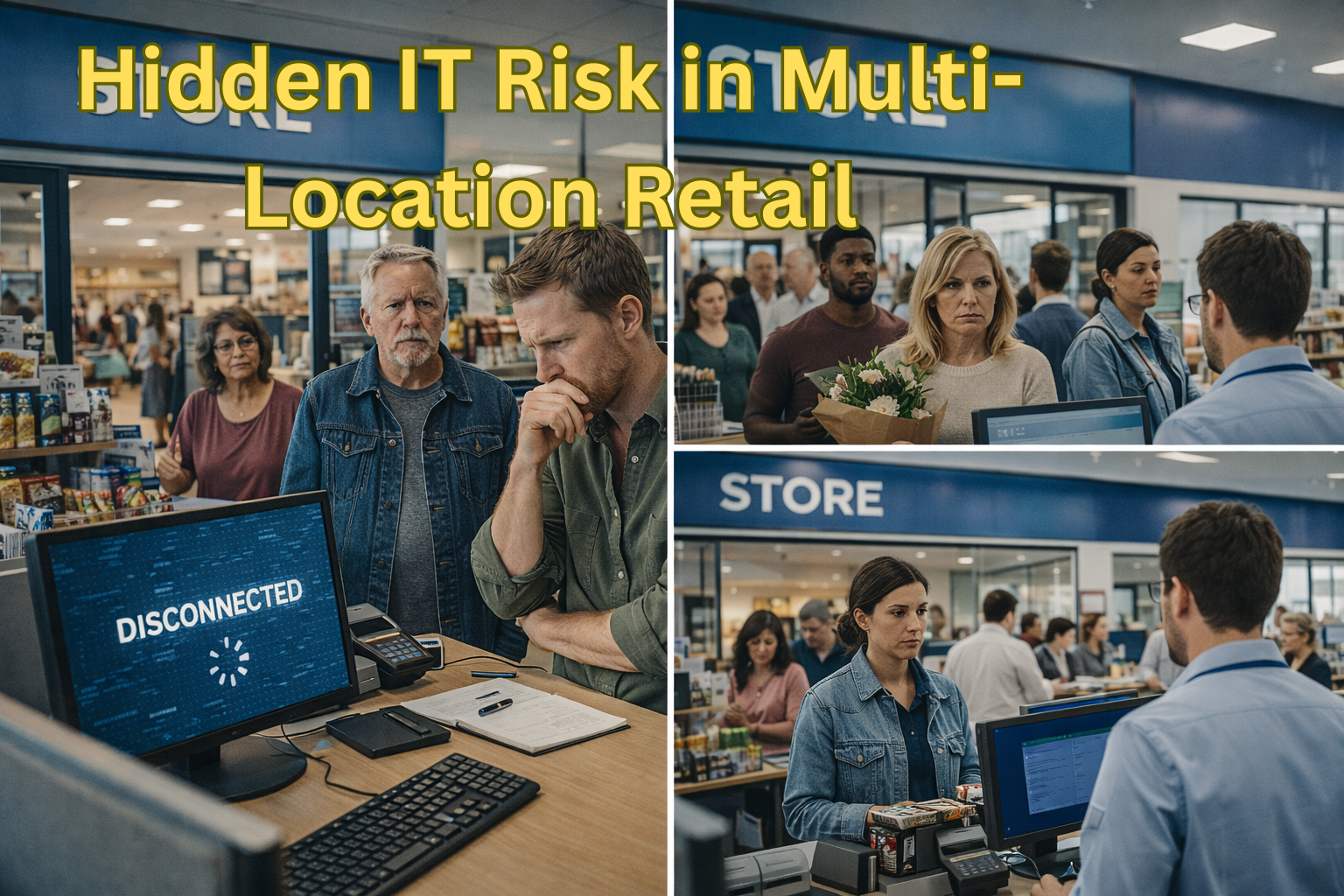
One store’s POS runs a little slower than the others.
Another location has a printer that jams daily but still “mostly works.”
A third location’s Wi-Fi drops randomly, but staff knows how to reconnect it.
Each issue feels isolated. Each one seems manageable. And because you’re running multiple locations, it’s easy to treat them as local annoyances instead of systemic warnings.
But multi-location retail doesn’t work that way anymore.
Today, every store is connected. Systems sync. Data flows constantly. A single weak point can ripple across your entire operation — affecting revenue, customer experience, staff morale, and brand reputation all at once.
Multi-Location Retail Is No Longer Just “More Stores”
Running multiple retail locations used to mean managing inventory, staffing, and merchandising across different addresses. Technology supported the business, but it wasn’t the business.
That has changed.
Today, multi-location retailers depend on technology for nearly every transaction and decision:
- Point-of-sale systems
- Inventory synchronization
- Payment processing
- Loyalty programs
- Reporting and analytics
- Vendor integrations
- Cloud-based management platforms
When systems work, operations feel smooth. When they don’t, chaos spreads quickly.
This is why Great Lakes Computer emphasizes a unified approach in Secure Every Storefront: Cybersecurity Strategies for Retail Multi-Location Businesses. Retail at scale requires consistency — not just in branding, but in infrastructure.
The Real Cost of Inconsistent Technology Across Locations
One of the biggest mistakes multi-location retailers make is allowing each store to evolve its technology independently. Different hardware, different configurations, different vendors, different levels of support.
At first, this seems flexible. In reality, it creates fragility.
When systems aren’t standardized:
- Troubleshooting takes longer
- Training becomes inconsistent
- Security gaps appear
- Reporting accuracy suffers
- Costs rise unpredictably
Eventually, leadership loses visibility. You stop trusting the data because you know each location operates a little differently.
Great Lakes Computer addresses this operational risk in Defending Your Registers: Cybersecurity Essentials for Retail Multi-Location Businesses, where they highlight how inconsistent environments increase both downtime and exposure.
Downtime Multiplies in Retail Environments
In retail, downtime is always expensive. In multi-location retail, it multiplies.
A POS outage at one store is a problem.
A POS outage across multiple stores is a disaster.
Sales halt. Customers leave. Staff scramble. Social media fills with complaints. And your brand takes the hit — not just one location.
Great Lakes Computer explores the business impact of response speed in Accelerating Business Success: The Importance of a Prompt IT Managed Service Provider Response. In retail, minutes matter. When systems are down during peak hours, revenue disappears immediately.
Cybercriminals Know Retail Can’t Afford Downtime
Retail is one of the most targeted industries for cybercrime — especially ransomware.
Attackers know three things:
- Retailers process payment data
- Retailers rely on uptime
- Retailers feel intense pressure to restore systems quickly
This makes multi-location retailers especially attractive targets.
Great Lakes Computer explains this risk clearly in Why Business Cybersecurity Is a Huge Problem for 2022 and Why SMBs Can’t Afford to Treat Cybersecurity as an Afterthought.
Once attackers gain access, they don’t just lock one system. They move laterally — jumping from store to store, server to server, until the entire environment is compromised.
POS Systems Are a Prime Target
Point-of-sale systems sit at the center of retail operations. They handle payments, customer data, and transaction history — all highly valuable information.
In Understanding POS Cash Registers, Great Lakes Computer outlines how modern POS systems are no longer standalone devices. They’re networked endpoints — and like any endpoint, they must be secured.
Unpatched POS devices, shared credentials, or unsecured remote access can expose every location at once.
Email and Credential Attacks Scale Fast
Email remains the most common entry point for retail breaches.
Fake vendor invoices.
Password reset requests.
Corporate-looking messages sent to store managers.
All it takes is one click at one location.
Great Lakes Computer has covered this extensively in Phishing Emails: Would You Take the Bait?, The Importance of Email Security, and Increase in Email Threats.
In multi-location retail, inconsistent training and shared credentials dramatically increase risk.
Ransomware Doesn’t Care How Many Stores You Have
Ransomware attacks don’t scale linearly — they scale exponentially.
In The Ransomware Tide Is Rising, Great Lakes Computer explains how attackers now automate their spread once inside a network.
For retailers, this can mean:
- Locked POS systems
- Inaccessible inventory data
- Broken supply chain integrations
- Complete operational shutdown
The only thing worse than a breach is discovering your backups don’t work.
Backup and Recovery Are Retail Survival Tools
Retail data changes constantly. Transactions, inventory levels, pricing, promotions — everything updates in real time.
That’s why backup strategy matters so much.
Great Lakes Computer stresses this in Nothing Is More Important Than Data Backup and Disaster Protection: Why Your Business Needs BCDR Now.
Backups must be:
- Automatic
- Secure
- Centralized
- Tested regularly
A backup that hasn’t been restored is not a plan — it’s a hope.
Inventory, Reporting, and the Cost of Bad Data
Multi-location retailers depend on accurate data to make decisions. When systems are inconsistent or unreliable, reporting becomes questionable.
Inventory discrepancies increase.
Reordering becomes reactive.
Forecasting loses accuracy.
Eventually, leadership stops trusting reports — and starts relying on gut instinct instead of data.
This is one of the most expensive hidden costs of poor IT infrastructure.
Cloud Platforms Help — When Properly Secured
Most multi-location retailers rely on cloud platforms for reporting, management, and integrations.
Cloud tools enable visibility and scalability, but they also introduce risk if misconfigured.
Great Lakes Computer addresses this balance in Cloud Computing in 2021 and How to Protect From Threats While Using Microsoft Office 365.
Cloud environments still require:
- Strong access controls
- Device security
- Backup of cloud-hosted data
- Monitoring for suspicious activity
Hardware and Print Still Matter in Retail
Despite digital transformation, retail still relies heavily on physical hardware.
Receipt printers, label printers, scanners, workstations, and network equipment all play a role in daily operations.
Great Lakes Computer supports retail environments through IT Hardware Maintenance and Repair and partnerships highlighted in Great Lakes Computer Forms Bixolon Partnership for Best-in-Class Printing Solutions.
When these systems fail, checkout slows, lines grow, and customers leave.
Why Centralized IT Management Wins in Retail
The most successful multi-location retailers centralize control while supporting local execution.
This means:
- Standardized hardware and configurations
- Central monitoring across all stores
- Consistent security policies
- Unified reporting and documentation
Great Lakes Computer explains the benefits of this approach in Why Your Business Needs a Managed Services Provider and Crucial Managed IT Services Benefits for Your Business.
Retail leaders shouldn’t be troubleshooting technology. They should be optimizing operations.
Employees Are the Front Line Across Every Store
Retail staff turnover is high. Training time is limited. And yet, employees interact with systems constantly.
This makes security awareness essential.
Great Lakes Computer emphasizes this in Build a Human Firewall for Your Business.
Simple, repeatable training reduces risk dramatically — especially when applied consistently across all locations.
A Practical IT Roadmap for Multi-Location Retailers
Retail doesn’t need complexity. It needs consistency.
Start by auditing every location. Identify differences. Standardize where possible. Secure access. Centralize monitoring. Verify backups. Train staff. And partner with experts who understand retail pressure.
Ideas and Recommendations for Multi-Location Retailers
If you’re managing multiple storefronts, these steps create immediate stability:
- Standardize POS, printers, and network equipment across locations
- Implement centralized monitoring for all stores
- Secure POS systems and payment environments
- Verify backup and recovery across every location
- Train store managers and staff on security basics
- Use managed IT services to gain visibility and control
- Treat IT as infrastructure — not an afterthought
These steps don’t slow growth. They protect it.
Final Thought
Multi-location retail success depends on consistency — in experience, operations, and technology.
When systems are reliable, customers trust the brand. When systems fail, they remember the frustration.
Great Lakes Computer helps multi-location retailers create stable, secure, and scalable IT environments that support growth instead of threatening it.
Because when one store goes down, they all feel it — and the right technology strategy makes sure that doesn’t happen.