There’s a moment many office-based mid-sized companies reach where something shifts.
You’re no longer a small team sharing a few computers and printers. You have multiple departments, dozens or hundreds of employees, shared files, cloud systems, remote access, compliance concerns, and customers who expect fast, flawless service. Technology is no longer a convenience — it’s the backbone of daily operations.
And yet, many companies are still managing IT the same way they did years ago: fixing issues as they arise, relying on internal staff who wear too many hats, and assuming things will “mostly work.”
That approach works — until it doesn’t.
What makes this stage dangerous isn’t a single failure. It’s the accumulation of friction. Slow systems. Minor outages. Security gaps. Confusion over responsibility. Over time, growth stalls, stress rises, and leadership spends more time reacting than moving forward.
The Unique Pressure on Office-Based Mid-Sized Companies
Mid-sized office environments sit in a difficult middle ground.
You’re too large for ad-hoc IT management, but not large enough to justify a full internal IT department with 24/7 coverage, cybersecurity specialists, and compliance expertise. Your teams depend on technology constantly, yet your systems are often stitched together from years of incremental decisions.
File servers, cloud platforms, printers, line-of-business software, remote access tools, and email systems all need to work together seamlessly. When they don’t, productivity suffers immediately.
This is why Great Lakes Computer emphasizes proactive strategy in Why the Demand for Outsourced IT Services Is Exploding. As companies grow, the cost of unmanaged complexity rises faster than most leaders expect.
When Technology Becomes a Bottleneck Instead of an Enabler
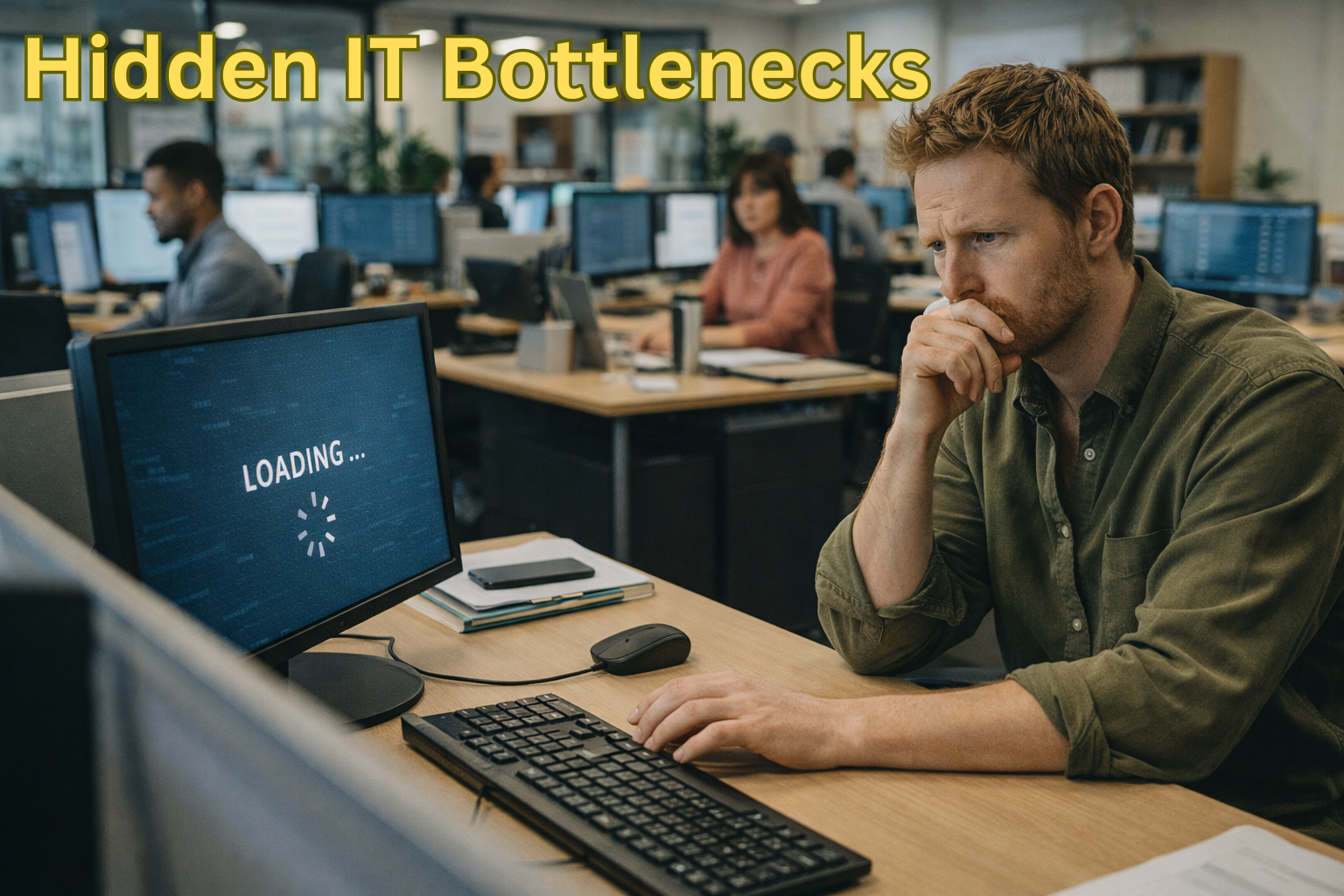
In healthy office environments, technology fades into the background. Employees focus on their work, not on troubleshooting systems. In struggling environments, technology becomes a daily obstacle.
Files take too long to open.
Applications crash unexpectedly.
VPN connections drop.
Printers slow entire departments.
Updates interrupt work hours.
Individually, these problems seem minor. Collectively, they drain productivity, morale, and momentum.
Great Lakes Computer addresses this reality in Simple Solutions to Productivity Blockers, showing how small inefficiencies compound into significant operational drag across teams.
Downtime Scales Faster Than Revenue
For mid-sized companies, downtime doesn’t just affect one employee or one customer. It ripples through departments.
When systems go down, accounting can’t bill, sales can’t access CRM data, operations can’t process workflows, and leadership loses visibility. Meetings stall. Deadlines slip. Customers wait.
The financial impact grows exponentially with size, which is why proactive response matters so much. Accelerating Business Success: The Importance of a Prompt IT Managed Service Provider Response highlights how faster resolution isn’t just about convenience — it directly protects revenue and reputation.
Cybersecurity Risk Increases as You Grow
Growth brings visibility, and visibility brings risk.
Mid-sized office-based companies are now prime targets for cybercriminals. You have valuable data, established revenue, and often weaker defenses than large enterprises.
Great Lakes Computer outlines this clearly in Why Business Cybersecurity Is a Huge Problem and Why SMBs Can’t Afford to Treat Cybersecurity as an Afterthought.
Threats rarely arrive loudly. They come through phishing emails, stolen credentials, outdated systems, or unsecured endpoints. One mistake can expose financial data, employee records, or client information.
Email Is Still the Most Dangerous Door In
Email remains the most common entry point for attacks, especially in office-based environments where communication volume is high.
Fake invoices, credential reset messages, vendor impersonation, and internal-looking requests all target busy employees who are trying to move quickly.
Great Lakes Computer has repeatedly addressed this risk in Phishing Emails: Would You Take the Bait?, The Importance of Email Security, and Increase in Email Threats.
Technical controls matter, but employee awareness is often the deciding factor between a near miss and a major incident.
Ransomware Is No Longer a Rare Event
Ransomware is no longer something that happens “to other companies.” It has become one of the most common and disruptive threats facing mid-sized organizations.
In The Ransomware Tide Is Rising, Great Lakes Computer explains how attackers deliberately target organizations that cannot afford prolonged downtime.
Once files are encrypted, operations stop. Payroll, billing, project work, and customer communication all grind to a halt. The pressure to pay grows by the hour.
This is where preparation — not panic — makes the difference.
Backup and Recovery Are the Line Between Delay and Disaster
Data loss doesn’t only come from cyberattacks. It comes from accidental deletion, hardware failure, software corruption, and power issues.
Great Lakes Computer stresses this reality in Nothing Is More Important Than Data Backup and Disaster Protection: Why Your Business Needs BCDR Now.
For office-based companies, backups must be automatic, secure, and tested. A backup that has never been restored is not a strategy — it’s an assumption.
Compliance Pressure Grows With Size
As companies grow, so do regulatory, contractual, and insurance requirements.
Cyber insurance applications become more detailed. Clients ask about security posture. Auditors expect documentation. Vendors require proof of controls.
Great Lakes Computer explores this evolving landscape in Cyber Insurance Is Becoming Harder to Obtain and Why Honesty Is the Best Policy: Tips for Completing Cyber Insurance Forms.
Without documented policies, monitoring, and controls, companies face higher premiums, denied coverage, or increased liability.
Cloud Tools Bring Flexibility — and Responsibility
Most mid-sized offices rely heavily on cloud platforms like Microsoft 365, file sharing tools, and cloud-hosted applications. These tools enable collaboration, remote work, and scalability.
However, cloud adoption does not eliminate responsibility.
Great Lakes Computer addresses this in How to Protect From Threats While Using Microsoft Office 365 and Cloud Computing.
Access control, endpoint protection, backup, and monitoring still matter. Without proper configuration, cloud platforms can expose more data, not less.
Hardware and Print Still Matter in Office Environments
Despite digital transformation, office-based companies still rely on hardware and print infrastructure. Printers, scanners, workstations, and network devices remain essential to daily operations.
When these systems fail, productivity slows across entire departments.
Great Lakes Computer supports these environments through IT Hardware Maintenance and Repair and Reduce Costs With Managed Print Services, helping companies reduce downtime, control costs, and secure sensitive documents.
The Hidden Cost of Internal IT Overload
Many mid-sized companies rely on one or two internal IT staff members to manage everything: support tickets, security, updates, vendor coordination, and strategic planning.
This is not a failure of those employees. It’s an unrealistic expectation.
Overloaded IT teams spend most of their time reacting. Strategic improvements get postponed. Security initiatives stall. Documentation falls behind.
This is why hybrid models — internal IT supported by managed services — are becoming the norm.
Why Managed IT Fits the Mid-Sized Office Model
Managed IT services provide structure where chaos tends to grow.
With proactive monitoring, standardized processes, and documented controls, companies gain stability without hiring a large internal team.
Great Lakes Computer explains this approach in What Are Managed IT Services? and 3 Reasons SMBs Need Managed Service Providers.
For mid-sized offices, this model delivers predictable costs, faster response, and stronger security — without sacrificing flexibility.
Employees Are Part of the Security Strategy
No security system works if employees are unprepared.
Training doesn’t need to be technical, but it must be practical. Employees should understand how to spot suspicious emails, protect credentials, and report issues quickly.
Great Lakes Computer emphasizes this human element in Build a Human Firewall for Your Business.
When employees are confident, incidents decrease dramatically.
A Practical IT Roadmap for Office-Based Mid-Sized Companies
Growth doesn’t require complexity. It requires clarity.
Start by assessing current systems honestly. Identify single points of failure. Document what exists. Fix recurring pain points before chasing new tools.
Secure access, back up data, monitor systems, and train employees. Then partner with experts who can maintain and improve that foundation as the company grows.
Ideas and Recommendations
If your office-based company is feeling growing pains, these steps create immediate traction:
- Conduct a full IT and security assessment
- Standardize hardware and software across departments
- Implement layered cybersecurity protections
- Verify backups and test recovery regularly
- Provide ongoing employee security awareness training
- Use managed IT services to reduce internal overload
- Align IT strategy with business goals, not just fixes
These actions don’t slow growth — they remove the obstacles that quietly block it.
Final Thought
Office-based mid-sized companies succeed when technology supports momentum instead of interrupting it.
Reliable systems, strong security, and proactive support don’t draw attention — they create confidence. Confidence in employees. Confidence in customers. Confidence in leadership.
Great Lakes Computer helps office-based organizations move from reactive IT to intentional infrastructure. Because growth should feel exciting — not fragile.